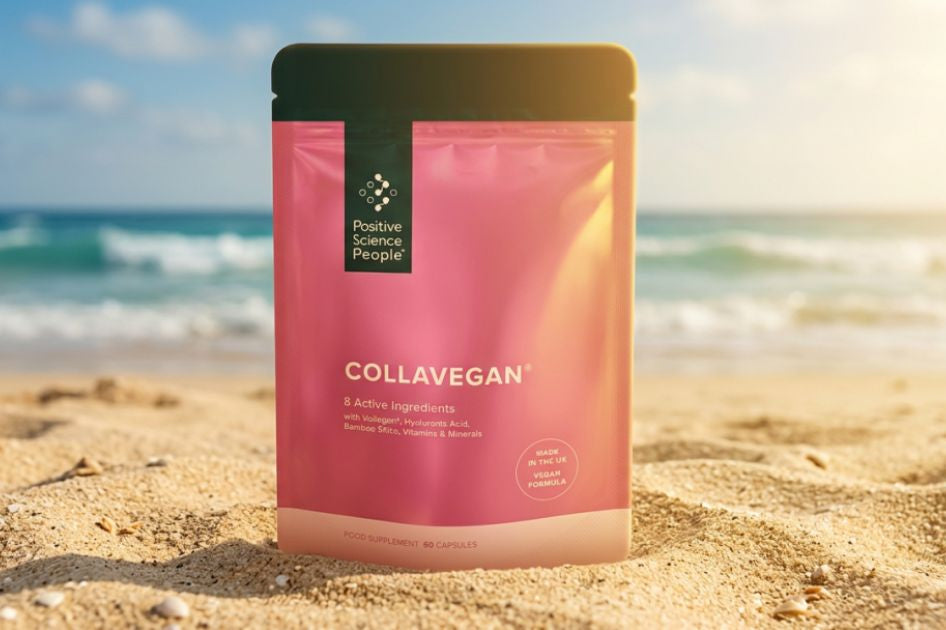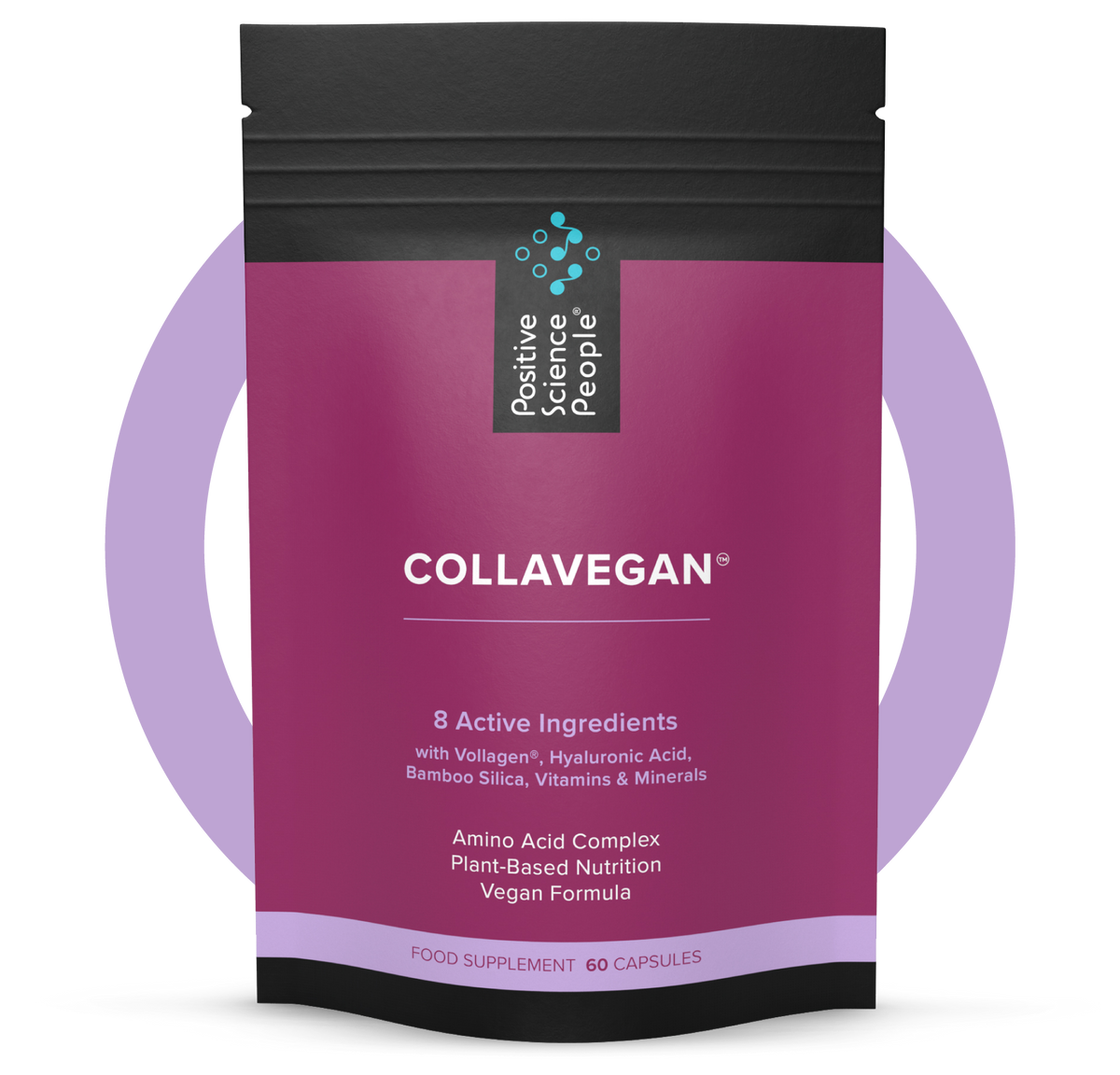
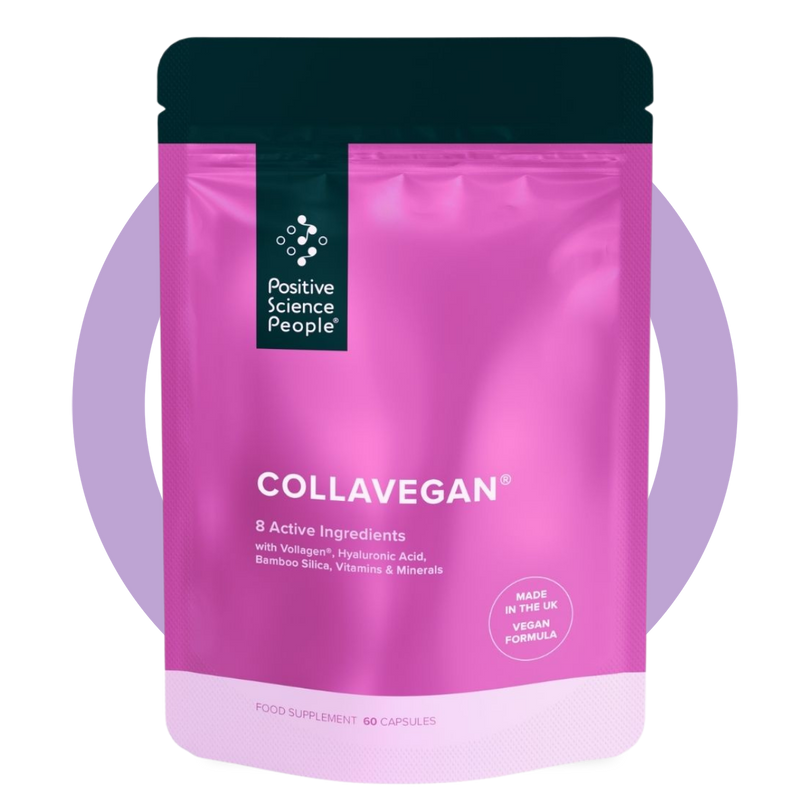

You've already made a great decision by adding Collavegan® to your routine. Here are three simple, science-backed habits that can help you get even more from it.
Taking a high-quality supplement is just the beginning. The truth is, your body's ability to build and maintain collagen doesn't happen in isolation — it depends on a network of biological processes that run around the clock. And some everyday habits you might not have connected to collagen can quietly either support or undermine the work that Collavegan® is doing for you.
The good news is that none of what follows requires a major overhaul of your life. These are small, manageable shifts that work with your supplement, not instead of it. Think of them as the conditions that help Collavegan® perform at its best.
1. Eat more Vitamin C (even though Collavegan® already contains it)
Collavegan® contains ascorbic acid (vitamin C) as one of its eight active ingredients, and that's no accident. Vitamin C isn't just a general health booster — it plays a specific and essential role in the body's ability to synthesise collagen.
Here's the biology, without the jargon. When your body assembles new collagen fibres, it relies on two key enzymes — prolyl hydroxylase and lysyl hydroxylase — to stabilise the structure. Vitamin C is a critical cofactor for these enzymes, preventing their auto-inactivation and enabling them to function properly in collagen biosynthesis. Wiley Online Library Without sufficient vitamin C, the body can still produce collagen — but it will be structurally weaker and less stable. Even with adequate glycine and proline available, collagen synthesis can stall if vitamin C status is insufficient, because production is often limited by this enzymatic activity rather than by amino acids alone. Momentous
So while the vitamin C in your Collavegan® capsules is doing important work, your overall dietary vitamin C levels matter too — particularly because the body cannot store large amounts of it and it needs regular replenishment. The good news is that topping up through food is easy and genuinely enjoyable.
Vitamin C-rich foods to weave into your daily meals:
- Red and yellow bell peppers (higher in vitamin C than oranges, gram for gram)
- Kiwi fruit
- Strawberries
- Broccoli and cauliflower
- Citrus fruits — oranges, grapefruit, lemons
- Blackcurrants (particularly rich, and very British)
You don't need to obsess over quantities. Simply making sure your diet regularly includes a variety of these foods means your body has the raw materials it needs to do its best work with the amino acids in Collavegan®.
2. Watch your sugar — It's quietly working against your Collagen
This one surprises a lot of people, because the connection between sugar and collagen isn't talked about nearly enough. Understanding it might genuinely change how you think about your diet.
When excess sugar circulates in the bloodstream, it doesn't just get stored as energy or fat. It also binds to proteins — including collagen — in a process called glycation. The result is the formation of compounds called Advanced Glycation End Products, or AGEs. The effect of sugars on ageing skin is governed by the way glucose and fructose link to the amino acids present in the collagen and elastin that support the dermis, producing these advanced glycation end products. PubMed
What do AGEs actually do? They accumulate in the extracellular matrix of the dermis, changing the balance between the synthesis and degradation of the extracellular matrix and ultimately leading to impaired skin homeostasis. Frontiers In practical terms, glycated collagen fibres become rigid and cross-linked — they lose their flexibility, their ability to repair themselves, and their capacity to hold moisture. The visible result is skin that looks stiffer, duller, and less plump. It's sometimes called "sugar sag" by dermatologists, and it's a very real phenomenon.
Critically, this process works against everything your Collavegan® is working towards. You're supplying your body with the building blocks to support collagen, while a high-sugar diet is simultaneously damaging the collagen you already have.
The solution isn't to eliminate sugar entirely — that's neither realistic nor necessary. It's about being mindful of the sources and quantities.
Some useful starting points:
- Reduce ultra-processed foods, fizzy drinks, and refined carbohydrates, which cause rapid spikes in blood glucose
- Tight glycaemic control over a four-month period can result in a meaningful reduction of glycated collagen formation Skin Therapy Letter — so consistency over time matters more than perfection on any given day
- Favour whole foods, fibre-rich carbohydrates, and meals that combine protein and healthy fats with carbs, which slow glucose absorption
- Antioxidant-rich foods — berries, green tea, dark leafy greens — can help protect against oxidative stress that accelerates glycation
You're already supporting your collagen from the inside. Keeping blood sugar relatively steady helps protect what you're building.
3. Prioritise sleep — It's when Collagen gets to work
This is perhaps the most underestimated habit on this list, and the science behind it is genuinely fascinating.
Your body doesn't operate at a constant level throughout the day. It follows a rhythm — during daylight hours, the focus is largely on defence: managing stress, responding to the environment, protecting skin from UV and pollution. At night, the mode switches entirely. As the body shifts into repair mode, growth hormones — which are primarily released during sleep — stimulate collagen production, contributing to skin structure, firmness, and barrier integrity. The Ordinary
This isn't just about feeling well-rested. Sleep deprivation accelerates skin ageing and reduces collagen production PubMed, and a peer-reviewed study published in 2025 specifically examined the relationship between sleep quality and the effectiveness of collagen supplementation, concluding that good sleep may meaningfully enhance the benefits of taking collagen peptides for the skin. Sleep disruptions or deprivation can impair essential processes including maintaining the skin barrier, collagen production, and cellular repair. MDPI
Think of it this way: Collavegan® gives your body the materials it needs to support collagen. Sleep is when your body is most actively doing the building work. Skimping on one means the other isn't working in optimal conditions.
There's also a secondary connection worth knowing. Collavegan®'s Vollagen® formula is rich in glycine — the primary amino acid in collagen — and research suggests that glycine promotes deeper, more restorative sleep by helping to lower the body's core temperature at night. So your supplement may actually be quietly supporting your sleep too, creating a positive loop between rest and repair.
Simple habits to protect your sleep quality:
- Aim for 7–9 hours consistently — regularity matters as much as duration
- Keep your bedroom cool and dark
- Avoid screens for at least 30 minutes before bed, which disrupts melatonin (your body's natural repair-signalling hormone)
- Limit alcohol in the evenings — it fragments sleep quality significantly, even when total hours feel sufficient
- Take your Collavegan® in the morning as directed, which aligns with the natural pattern of collagen metabolism throughout the day
Putting it all together
None of these three habits is complicated, and none of them requires you to make dramatic changes. What they share is that they work with your biology — supporting the conditions your body needs to make the most of what Collavegan® is providing.
You're already taking a science-backed, award-winning supplement that delivers the collagen-equivalent amino acids your body needs, along with hyaluronic acid, bamboo silica, and key vitamins and minerals. Pairing that with a diet rich in vitamin C, mindful of sugar, and supported by good sleep is the complete picture.
We want you to see results — and these habits make that considerably more likely.
As always, if you have questions about Collavegan® or how it fits into your wider health routine, our team is here. And if you're ever unsure about combining supplements with medication or existing health conditions, please speak with your GP or healthcare practitioner.
Positive Science People. Made in England. Evidence-based, always.